

Quick answer
A coworking space is not one office with one team. It is a building shared by dozens of businesses, with more people passing through, heavier use of kitchens, meeting rooms, and washrooms, and opening hours that often leave no clean, empty window.
The right cleaning brief reflects that: a main clean outside core hours, daytime cover for shared areas, resets tied to the room-booking and events calendar, and a clear split of responsibility between the operator, the landlord, and members with private offices.
Key takeaways
- Shared kitchens, meeting rooms, and washrooms decline faster in coworking spaces than in single-tenant offices, so they need attention during the day, not only overnight.
- Cleaning schedules should follow the operator’s booking and events calendar rather than a fixed nightly routine.
- The contract needs to state who is responsible for common areas, private offices and consumables before cleaning starts.
- Choose a contractor on scheduling flexibility, quality auditing and access control, not on price per hour alone.
How is cleaning a coworking space different from cleaning a standard office?
- In a standard office, the cleaning brief serves one organisation with predictable hours and a fixed headcount. In a coworking space, your members arrive at different times, use the space in different ways, and judge the operator, not the cleaner, when something is left undone.
- The scale of the sector in London makes this a common challenge. Greater London had 1,209 coworking locations in the first quarter of 2026 (CoworkingCafe, 2026), and average occupancy across London’s flexible workspace reached 83.8% in the six months to March 2026 (Workspace Intelligence Network, 2026). High occupancy means more people sharing the same kettles, tables, and toilets every day.
Three differences shape the brief:
- Footfall is higher and less predictable. Day-pass users, visitors, event guests and members’ clients add traffic that a desk count does not capture.
- Shared spaces carry most of the load. Members rarely clean up after themselves in the way a single team might in its own kitchen.
- The cleaning window is shorter. Many spaces open early, close late, or offer 24-hour access, so there is less time when the building is empty.
Which areas of a coworking space need the most attention?
Shared kitchens and breakout areas
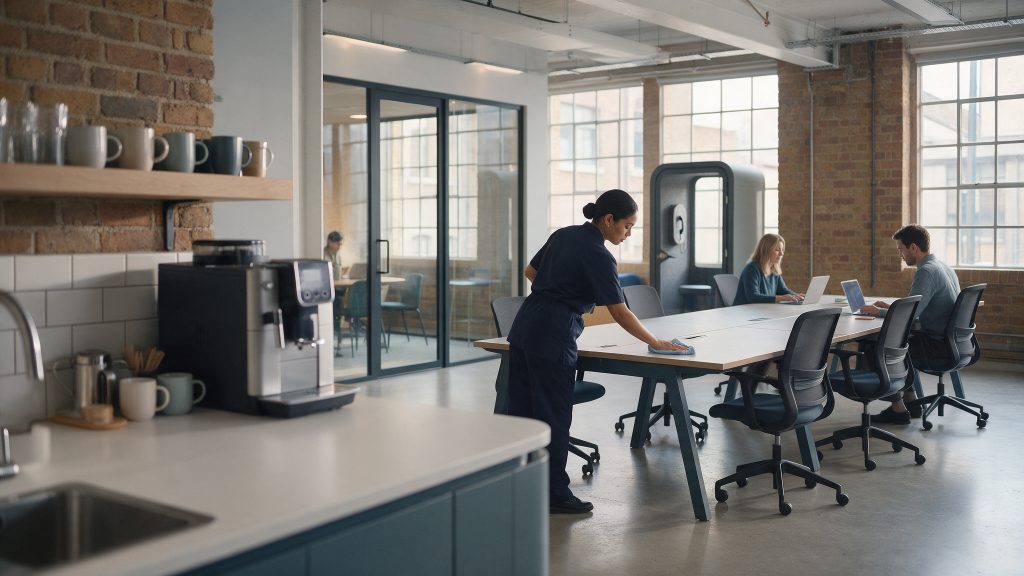
The kitchen is usually the first place members notice a lapse. Worktops, sinks, coffee machines, fridges, and dishwashers see constant use, and by mid-afternoon, a kitchen cleaned only overnight can look neglected. Fridge clear-outs need a policy agreed with the operator, so members know when unlabelled food will be removed.
Meeting rooms and phone booths
Meeting rooms are booked back-to-back, often by different businesses. Each booking expects a clear table, a clean whiteboard, and empty bins. Phone booths are small, enclosed, and used by many people in a day, so door handles, desks, and screens need regular wiping.
Hot desks and touchpoints
Hot desks have no owner, so nobody wipes them down at the end of the day. Desk surfaces, monitor arms, chair arms, light switches, lift buttons, and door handles all need a defined frequency.
Washrooms
Washrooms in a busy coworking space need checking and restocking during the day. Running out of soap or paper at 2pm generates more complaints than almost any other cleaning issue.
Reception, lounges, and event spaces
Reception is the first impression for members’ clients and prospective members on a tour. Event spaces need a full reset after evening events so the room is ready for the next morning’s bookings.
When should a coworking space be cleaned?
Most coworking spaces work best on a split schedule rather than a single nightly clean. The aim is to do noisy, intensive work when the space is quiet and keep shared areas usable while members are in.
- Main clean: early morning or late evening, outside core hours. This covers vacuuming, floor care, full washroom cleans, and desk wipe-downs.
- Daytime cover: a day cleaner or porter for kitchens, washrooms, meeting room resets, and spills. Quiet methods matter here because members take calls and video meetings in open-plan areas.
- Event resets: scheduled around the events calendar, often late evening or first thing the next morning.
Agree on quiet hours with the operator and share the room-booking calendar with the cleaning team. A meeting room cleaned at 6am does little good if it was used for an event at 9pm and booked again at 8am.
What should a coworking cleaning specification include?
A useful specification separates tasks by frequency, so everyone can see what happens when. The detail will vary by building and membership, but a typical structure looks like this.
Throughout the day
- Kitchen worktops, sinks, and coffee areas wiped and cleared
- Dishwasher loaded, run, and emptied
- Washrooms checked and consumables restocked
- Meeting rooms reset between bookings where scheduled
- Spills and visible debris dealt with in shared areas
Daily
- Hot desks and shared tables cleaned
- High-touch points wiped: door handles, lift buttons, light switches, phone booth surfaces
- Bins emptied and recycling separated
- Floors vacuumed or mopped throughout
- Washrooms fully cleaned
Weekly
- Fridges cleared of out-of-date and unlabelled items, in line with the operator’s policy
- Kitchen appliances cleaned inside and out
- Soft furnishings in lounges vacuumed
- Internal glass and partitions cleaned
Periodic
- Carpet and upholstery deep cleans
- Hard floor treatments suited to the floor type
- High-level dusting and vents
- Deep cleans of private offices when they change hands between members
Who should hold the cleaning contract: the operator or the landlord?
Flexible workspace comes in several models, and the right answer depends on which one you run.
- Operator-leased space: the operator usually holds the cleaning contract for everything within its floors, while the landlord cleans the building’s common parts.
- Management agreements: the landlord owns the space and an operator runs it. The contract may sit with either party, so the agreement should say who instructs the cleaners and who pays.
- Landlord-run flex floors: landlords offering their own flexible floors within a multi-let building often extend their existing cleaning contract, but the coworking floors need their own specification rather than the standard tenant one.
In every model, settle three questions in writing before cleaning starts: whether members’ private offices are included or charged separately, who supplies consumables such as soap, paper, and dishwasher tablets, and who the cleaning team reports to day to day.
Does the location in London change the brief?
It often does, because coworking spaces in London sit in very different buildings. In Shoreditch, Clerkenwell and Farringdon, many spaces occupy converted warehouses and Victorian commercial buildings, with exposed brick, timber floors and polished concrete that each need the right products and methods. If you operate in this area, our page on office cleaning in EC1 covers the district in more detail.
Around King’s Cross, London Bridge and Canary Wharf, coworking floors are more often inside large managed buildings, where the landlord sets access hours, loading bay rules and contractor induction requirements. Your cleaning contractor needs to work within those rules from day one. For operators further east, see our East London office cleaning page.
What should you look for in a cleaning company for a coworking space?
The best cleaning company for a coworking space is the one whose working methods fit a shared, busy, long-hours building. When you compare contractors, ask about these points.
- Experience with multi-occupancy buildings. Ask a prospective contractor how they handle a building where dozens of businesses share the same facilities.
- Flexible scheduling. Check they can provide daytime cover alongside an out-of-hours clean, and adjust around your events calendar.
- Cover for absence. Ask what happens when your regular cleaner is off sick or on holiday, and how quickly a replacement is briefed.
- Quality auditing. A quality management standard such as ISO 9001 shows there is a documented process. Ask how often audits take place and how you see the results.
- Vetting and key control. Members’ private offices may hold confidential material, so ask how staff are vetted and how keys and access cards are managed.
- Room to grow. If you plan to add floors or sites, check the contract and the team can scale without starting from scratch.
For a wider view of how commercial contracts are scoped, see our office cleaning services in London.
Common mistakes when cleaning coworking spaces
- Copying a standard office specification. Kitchens and meeting rooms decline by mid-afternoon, and members notice before the operator does.
- Cleaning only out of hours. Nothing gets reset between the morning rush and afternoon bookings.
- Ignoring the events calendar. A meeting room booked for 9am still holds last night’s event.
- Leaving private office responsibility unclear. Some offices are cleaned twice and others not at all, and the complaints go to the operator.
- Giving members no way to report issues. Small problems reach the cleaning team as formal complaints rather than quick fixes.
- Fixing the specification when occupancy changes. You either pay to clean empty floors or under-serve the busiest ones.
Frequently asked questions
Daily as a minimum, with daytime cover for kitchens, washrooms and meeting rooms in busier spaces. The right frequency depends on member numbers and opening hours.
Yes, for kitchens, washrooms, meeting room resets, and spills, use quiet methods. Noisier work, such as vacuuming, is best scheduled outside core hours.
That is agreed between you and the contractor. Private offices can be included in the main specification, cleaned on a separate schedule, or left to members, depending on your membership terms.
This is set out in the contract. Agree it upfront so washrooms and kitchens are never left without stock.
Costs depend on floor area, footfall, opening hours, cleaning frequency and whether daytime cover is needed. Our guide to what affects the cost of office cleaning explains each factor.
In most cases, yes. Build a review point into the contract so the specification can follow occupancy. Get in touch to request a tailored quote for your workspace.